How Mary Colter Got Her Job with the Fred Harvey Company
If you've seen the Watchtower at Desert View, Bright Angel Lodge or Hermit's Rest, you've seen the work of one of the most remarkable folks who ever set foot on the South Rim. Her name was Mary Colter. And the way she landed her job with the Fred Harvey Company is a better story than most folks know.
I'm the Canyon Cowboy, a time-travelin' rascal from about a hundred years back, a fictional character created by Stephen Root, Flagstaff local, exploring the Grand Canyon region for twenty-plus years. Pull up a stump, friend, and I'll tell you how a schoolteacher from St. Paul, Minnesota ended up bossin' crews of rough-handed men on the edge of the Grand Canyon.
Watch the video: How Mary Colter Got Her Job with the Fred Harvey Company
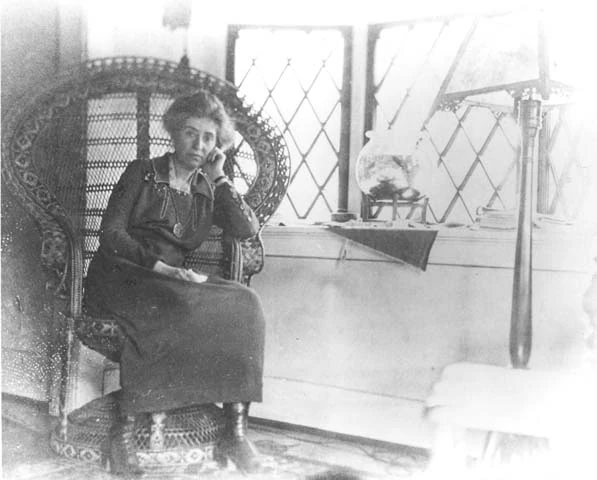
Mary Colter, around age 50, circa 1919.
A drawing teacher with an architect's training
Before she ever drew a line for Fred Harvey, Mary Colter was a high school drawin' teacher in St. Paul. She taught there for the better part of fifteen years.
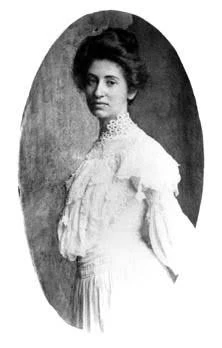
Mary Colter, circa 1892, around the time she began teaching in St. Paul.
But she wasn't just any teacher. While she was studyin' at the California School of Design in San Francisco, she'd apprenticed in an architect's office. That's where she learned how buildings come together, from the ground up.
She'd also made a name for herself around St. Paul givin' talks on Native American arts and crafts. One of 'em, back in 1901, was called "Primitive Arts and Crafts," and it came with real Native handiwork to show the crowd. That interest would turn out to matter a whole heap.
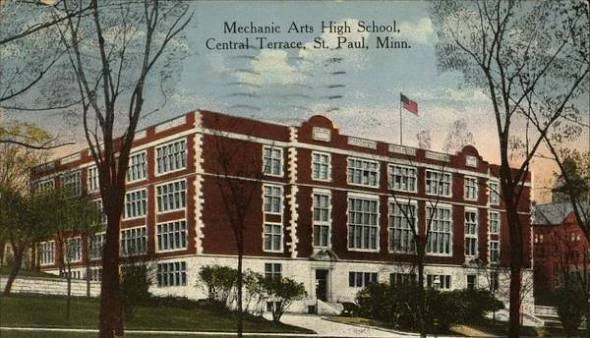
Mechanic Arts High School in St. Paul, Minnesota, where Mary Colter taught drawing.
Minnie Harvey and the Indian Department
Now let me introduce you to Minnie Harvey Huckel, Fred Harvey's daughter. Minnie was a collector of Native American art herself.
In 1902, Minnie and her husband, J. F. Huckel, encouraged the Fred Harvey Company to start sellin' Native art to travelers. The company set up an Indian Department to buy, display and sell it.
So there was a company that needed somebody who understood Native art and knew how to design a space. And there was a drawin' teacher in St. Paul who fit that bill to a T.
How Mary Colter got the gig
Here's where the trail gets a little dusty, friend, because nobody's quite sure how the two found each other.
Story goes, Minnie met Mary at a ladies' club in St. Paul and figured she was just the gal for the job. One biographer tells it that way.
Another biographer tells it different. In that version, Mary was visitin' a friend at a gift shop in San Francisco and told the manager she'd sure like to work for Fred Harvey.
One local historian put it plain: the circumstances of how she was picked just aren't clear. I like both versions, so I'll let you pick your favorite.
The Indian Building in Albuquerque
However it happened, in 1902 the Harvey folks sent for her.
The Santa Fe Railway's new Alvarado Hotel opened in Albuquerque that year, and right next to it stood the Indian Building. Inside were displays of Native-made pottery, baskets and textiles, with Navajo weavers and silversmiths workin' right there on site. Mary's job was to design the inside and make the whole thing shine.
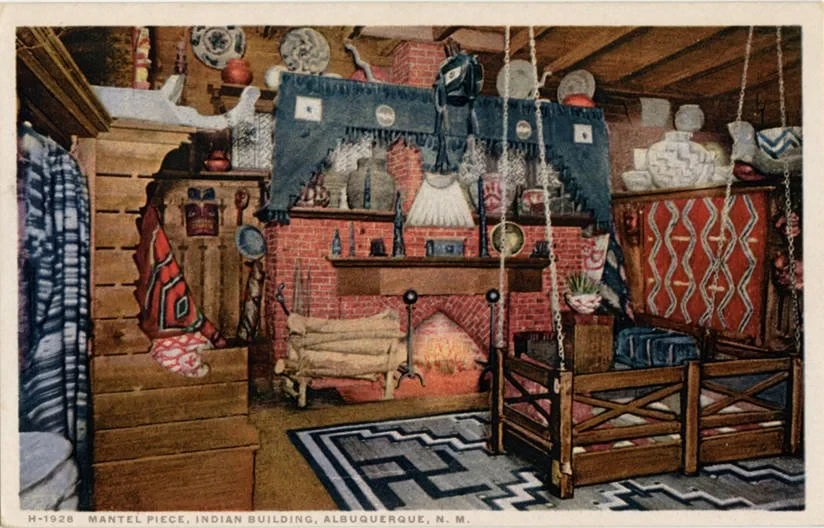
The mantel piece in the Fred Harvey Indian Building, next to the Alvarado Hotel in Albuquerque.
And shine it did. The Harvey folks were tickled pinker'n a sunburned tenderfoot.
Back to the chalkboard, then back out West
You'd figure a job like that would set her up for life. Nope. Once the work was done that summer, Mary moseyed right back to St. Paul and her chalkboard.
But the Harvey Company didn't forget her. A few years later, they hauled her back out West to design Hopi House, set right across from El Tovar Hotel on the South Rim. It opened in 1905.
Then in 1910, when she was forty-one years old, the Fred Harvey Company finally hired her on full time as an architect and designer.
Her buildings on the South Rim
Once she was on the payroll, she went to work on the South Rim. Here's the short list of what she designed there:
- Hermit's Rest, 1914
- Lookout Studio, 1914
- Desert View Watchtower, finished in 1932
- Bright Angel Lodge, 1935
Add Hopi House to that and you've got a big piece of what folks picture when they think of the South Rim today.
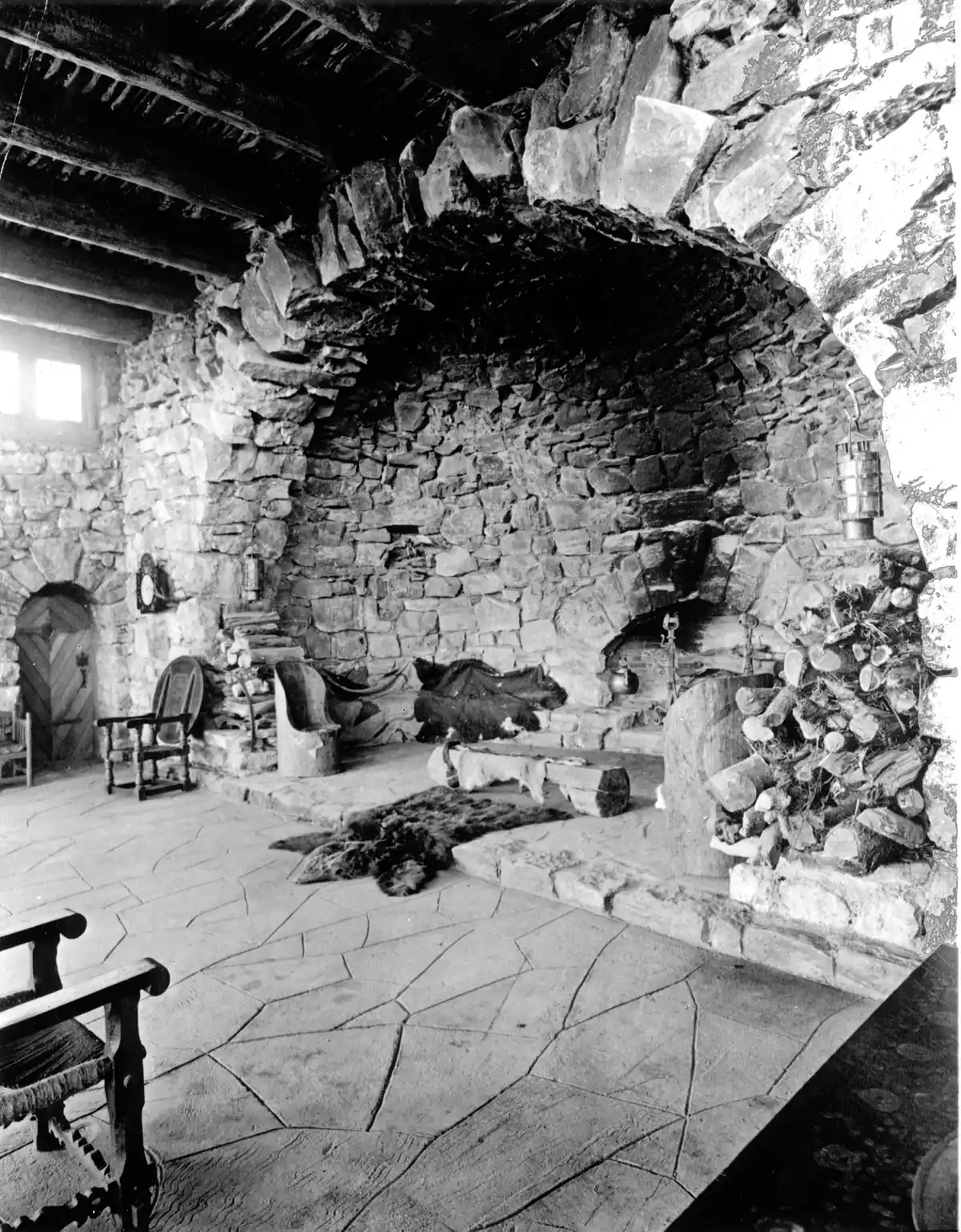
The fireplace alcove inside Hermit's Rest on the South Rim, designed by Mary Colter in 1914. Photograph circa 1916.
No license, and a crew that didn't love her
Here's the kicker. Mary Colter never held an architect's license. She trained back before licensing was required, and her spot with the Harvey Company and the Santa Fe Railroad let her work without one.
That meant the railroad's engineers signed off on her official drawings. So on paper, the fellas got the credit. Out on the job, though, they got the orders.
And from what I hear, those crews weren't too keen on takin' orders from a lady. Word is, one employee told her biographer that everybody hated to see her comin' on the job. I figure they were 'bout as happy to see her as a mule is to see a saddle.
She didn't care much. She got the job done.
See Mary Colter's work for yourself
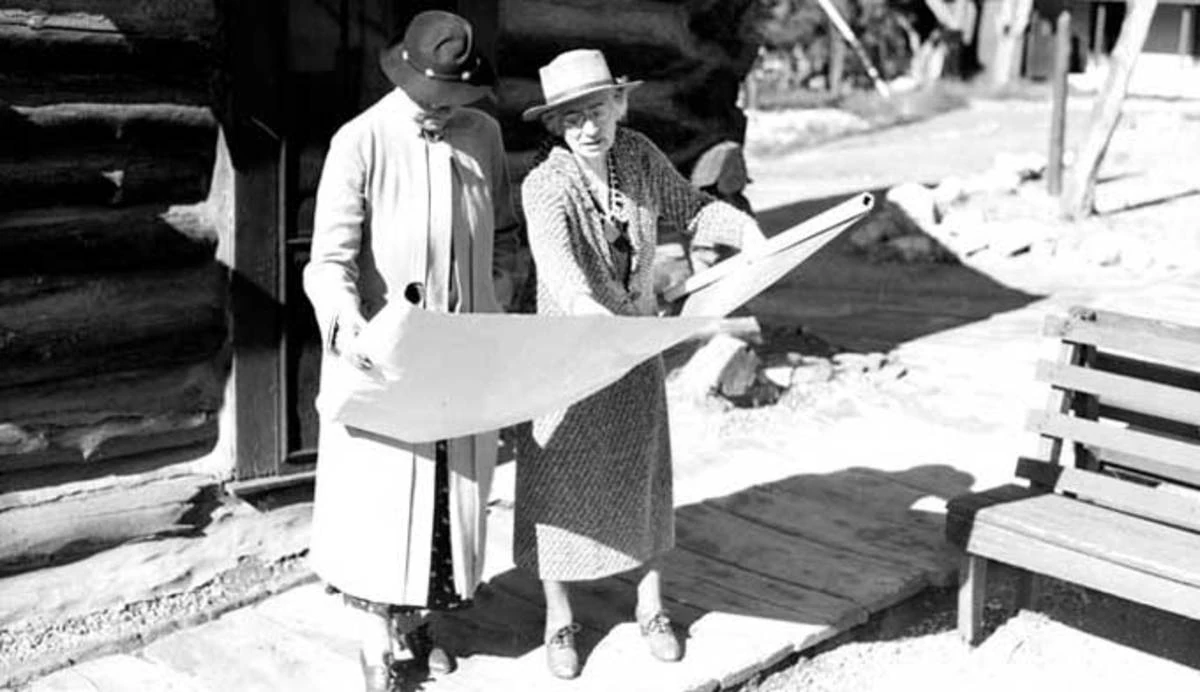
Mary Colter (right) showing a blueprint to Anna W. Ickes, wife of the Secretary of the Interior, circa 1935.
Next time you're at the South Rim, make a day of it. Start at Hopi House across from El Tovar, then work your way to Lookout Studio, Bright Angel Lodge, Hermit's Rest and the Watchtower out at Desert View. Every one of 'em has a schoolteacher from St. Paul behind it.
Get my free Grand Canyon Cheat Sheets
Plannin' a trip to see it all? Let me save you some guesswork.
My free Grand Canyon Cheat Sheets give you a page for every route in, from Las Vegas, Phoenix, Flagstaff, Sedona, Williams, Page and St. George. Every page has a map, where to stay, the can't-miss stops, the famous grub, drive times and when to go. Print 'em out, toss 'em on the dash, and you'll roll in knowin' exactly where you're headed while everybody else is still squintin' at their phones.
Tell me where to send 'em at grandcanyonposse.com/cheat, and they're yours, free.
See you on the rim.
The Canyon Cowboy

